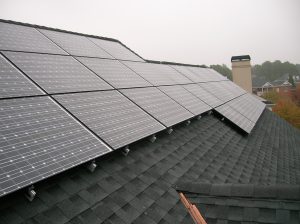
Solar PV Safety on Rooftops. AC vs. DC
Two very important safety concerns with electricity are open-arcs and short-circuits. An open-arc is when a conductor (electrical wire) is cut, but the voltage is able to jump across the gap to complete the circuit and create a very high temperature arc and this is a fire hazard. A short-circuit is when the conductor insulation is cut and the bare conductor unintentionally touch a conductive material that is not a part of the circuit. This could be a metal support or a person’s skin, creating a possibility of shock and fire.
It is good to understand the range from relatively safe to hazardous conditions with electricity , as well as the conditions that make it hazardous.
- Voltage is the force, and current is the flow of electricity. Voltage without current is only potential for power, and the same can be said for current without voltage.
- The first thing to understand is higher voltage increases the force or length of an open arc. That means that the higher the voltage, the more easily it will move though a person’s body or the greater distance it will travel though open air to complete a circuit. That makes high voltage more hazardous than low voltage; 30v or less is considered safe from electrical shock or fire causing arcs. But without current there is zero energy or hazard.
- Electrical current is the second part of electricity that creates power. It is the flow of electron energy. Current multiplied by voltage = power; power is the energy we use and the energy that is potentially hazardous.
- When voltage and current are applied, a DC electrical arc is about 10 times hotter than an AC electrical arc. Regarding fire potential from an arc, DC is 10 times the hazard of AC.
Solar on the roof is a serious safety issue.
High voltage DC system on a roof that feed into a string inverter create a potential for fire because the temperature is high when an arc occurs. PV inverters have arc-fault detectors that shut the inverter down in case an arc is detected in the DC circuit. But if you have a short-circuit and arc-fault event occurring at the same time, the inverter shutdown may not extinguish the arc. The DC arc can create enough heat to causes shorting throughout the DC circuit including the PV module; this is an additional fire potential.
Micro-inverter systems on the roof have a DC voltage around 30v and is then converted to AC voltage. The AC circuit is protected by overcurrent device breakers and will shut down if a short occurs. If a conductor is partially cut, the arc is 1/10th the temperature of its DC equivalent, so it is much safer. Run the conductors in metal conduit and there is almost zero hazard concern.
In my opinion, residential rooftop PV installations should all be with micro-inverters.
Solar PV Associate Technician course bundle, PV201 and PV202
Kelly Provence
IREC Certified Master PV Trainer
info@solairgen.com
(800) 262-7560